Shawn Lyons Story
Rabbit markets itself as an anomaly in an industry with a bad rep, capitalizing on a staff of artistic types, word-of-mouth referrals, and a Web site that posts positive customer testimonials and descriptions of extra services traditional moving companies don't usually offer.
So far, Rabbit's bare-bones sales and marketing strategy—except for maintaining its site, the company spends no money on advertising—is working. Rabbit's founder, former itinerant writer Shawn Lyons, who started the moving company in 2004 for $1,500—the cost of a 1981 Dodge Ram cargo van—estimates revenues will be around $300,000 in 2006. This is up one-third from a year ago. "Originally, I was just going to do the 'man with a van' thing and have time to write," Lyons says.
But about nine months into helping friends move their furniture in his spare time, Lyons decided he was onto something because demand kept increasing. So he pursued the licensing and insurance required by New York City and State and started to build Rabbit into more than just a traditional moving company, carving out a niche with young urban dwellers.
Today Rabbit, apart from making residential and commercial moves within the New York metro area and renting storage space, also offers massages ($80 per hour) and feng shui ($200). Clients normally take advantage of these extras after the move. Moving prices range from $100 an hour to a flat $1,500 for a complicated, labor-intensive move that includes packing.
Toby MacPhearson, a 31-year-old information-technology worker in Manhattan, paid Rabbit about $650 to move from the neighborhood of Chelsea to Hell's Kitchen, and is glad he took advantage of the feng shui service. "I was mostly in it for the practical aspect: It helped me reduce my stress by helping me set up the apartment in a logical manner," says MacPhearson, who has since referred two friends to Rabbit.
Still, Rabbit is a tiny presence in an industry that generates approximately $7 billion a year in revenues and employs an estimated 450,000 workers. David Sparkman, a spokesperson for the American Moving and Storage Assn. (AMSA), an industry advocacy group with 3,400 members, estimates that there are 5,000 to 6,000 mostly small, family-owned moving companies, with just a handful of large van lines.
With so much competition out there, concentrating on a unique group of customers has helped Rabbit establish a strong reputation. Apart from Rabbit's positive plugs in its Web site's testimonials section, sites like Apartmenttherapy.com and Brooklynian.com include posts such as: "Rabbit Movers are awesome. I've used them and passed them on to friends as highly highly recommended."
That seal of approval lends multiple benefits to Rabbit. "The notion of community in an urban setting leads to positive word of mouth, customer loyalty, and branding, and it seems like Rabbit has all of those," says Heidi Neck, assistant professor of entrepreneurship at Babson College.
Those who hire Rabbit to help them move shouldn't expect stereotypical movers. "Most of our guys are artists or in some creative field; they're just a really creative bunch," says Lyons, who counts chefs, painters, musicians, and writers ranging in age from 23 to 43 as his employees. "We're trying to move away from the perception of movers being supermacho creeps. Movers kind of have a bad rep in New York, and for good reason. There are a lot of scams, so we try to combat that," he says.
Aside from wanting to work with people whom he liked on a personal level, Lyons says it was easier to communicate the tone he's trying to create for the company to people who already intuitively understood it through their own experience. Trying to nurture friendly interactions with clients further sets Rabbit apart from the competition.
Since good employees are the key to creating a good moving experience, Rabbit pays fair wages across the board. Lyons says most of his movers make between $13 and $15 an hour, while many other companies pay workers under the table or at minimum wage. Keeping morale up, he says, is a necessity when your primary selling point is alleviating stress for the customer.
Also atypical of a moving company: Rabbit's community of young movers and customers is forming around the Brooklyn art scene. Lyons studied literature and writing at Temple University in Philadelphia and wanted to have his career fit with his creative background. So he recently bought and renovated a space in Brooklyn's Dumbo neighborhood (Dumbo stands for Down Under the Manhattan Bridge), where he now rents space for artists to display their work.
Not directly related to Rabbit's moving business but intimately connected with its people and its style, the studio will host exhibitions at this year's Dumbo Arts Festival, and some of the artists will be Rabbit's own movers. Lyons says most of the people he expects to attend the exhibition are former customers who asked to be added to the Rabbit mailing list.
The company also specializes in moving art for galleries. Lyons says the movers' appreciation for the work establishes a trust between them and the client. "What's really great is that they're not just movers, they're really smart guys. In a business you need things that are malleable—people who are quick and able to adjust to what you need," says Priyanka Mathew, gallery director for Gallery Arts India, one of Rabbit's clients, and a former banker at Goldman Sachs. Mathew says Rabbit has moved scores of contemporary Indian paintings and sculptures without damaging a thing.
The company also employs a design aesthetic on its Web site, trucks, and T-shirts that appeals to its target demographic of young urbanites. "I just went along with what I would want in the aesthetic of the designs, the character, and quality of the movers. So far it's working, I think," says Lyons.
Rabbit's faithful clients—Mathew included—agree that the company's got staying power. "I really think this is the way that business is going to be moving—especially small business. You have to be sound fundamentally, but to create a niche and an edge, you've got to try and differentiate yourself, and that's what Rabbit does very well," says Mathew.
http://uncommonbusiness.blogspot.com
Sunday, October 15, 2006


7 Things You Should Know about Podcasting

John had to leave class a bit early last Monday, but
he knew he could catch up on all of the missed ma-
terial by subscribing to his professor’s podcast and
downloading the recording to his MP3 player. As he
headed for the bus that Wednesday morning, he was
confident that he would be as prepared as his friend
Joanne. She had stayed through the whole class and
reported that there had been an interesting issue dur-
ing the end-of-class demonstration. Walker, the class
clown, had tried to match wits with the instructor’s
(again) and had almost won. “Check it out, John!”
she said.
As John rode the bus, he searched for the “incident”
and listened intently. The atmosphere in the lecture hall
was electric—and the laughter and banter in the class
could be clearly heard through his headphones.
By the time he got off the bus, John felt he hadn’t
missed too much—the podcast had been nearly as
good as being there in person. He also knew that he
would now have enough questions for the interview
he was conducting later in the day of a visiting wildlife
conservationist. Part of the reason she had agreed
was John’s promise to share the session with his col-
leagues—via a podcast.
“Podcasting” is a term inspired by the Apple Computer Corpo-
ration’s iPod—a portable digital audio player that allows users to
download music from their computer directly to the device for
later listening. The term is no longer specifically related to the
iPod but refers to any software and hardware combination that
permits automatic downloading of audio files (most commonly in
MP3 format) for listening at the user’s convenience. Unlike tradi-
tional radio or other Web-based streaming media, podcasts give
listeners control over when they hear the recording. Podcasting
makes use of the Internet’s Real Simple Syndication (RSS) stan-
dard. It differs from broadcasting and Webcasting in the way that
content is published and transmitted via the Web. Instead of a
central audio stream, podcasting sends audio content directly to
an iPod or other MP3 player.
Podcasting can involve practically anyone with an Internet con-
nection. With its roots in the blogging world, part of the appeal of
podcasting is the ease with which audio content can be created,
distributed, and downloaded from the Web. Professional broad-
casters and syndicated radio shows are starting to make their
content available as podcasts. Amateurs are flocking to podcast-
ing, sharing their content and opinions. Campuses are starting to
make content available as podcasts as well.
Podcasting is a unique innovation in content publishing based in
large part on its inherent simplicity and ease of use. Users simply
connect their portable audio devices to their computer, log on to
a podcasting subscription service, and subscribe to that site’s
feeds. Audio content is then “pushed” from the original source
directly and automatically to the user’s iPod or MP3 player. All of
the tools needed to create, modify, and distribute podcasts are
within reach of anyone with a reasonably well-configured laptop.
The desire to improve the quality of podcasts has resulted in rich
Web-based resources outlining principles of sound, equipment
recommendations, and shared experiences. Podcasting dem-
onstrates the power of audio over text (listening as opposed to
reading), allowing podcast users to listen and learn while they
walk, jog, ride the bus, or are otherwise away from their com-
puter screen. Perhaps most significantly, podcast technology
empowers users to publish audio content directly and seam-
lessly onto the Web.
Podcasting allows education to become more portable than
ever before. Podcasting cannot replace the classroom, but it
provides educators one more way to meet today’s students
where they “live”—on the Internet and on audio players. Barri-
ers to adoption and costs are minimal. The tools to implement
podcasts are simple and affordable. Podcasting is predicted to
soon become a mainstream application, much like video-on-
demand recorders (such as TiVo).
Users must have sufficient bandwidth to download the podcast.
Beyond access, there are potential issues with the format. Pod-
casting is primarily an audio delivery technology and, as such,
has limited usefulness for the hearing impaired. Podcasting is
not designed for two-way interaction or audience participation.
Podcasters are essentially “sound amateurs” producing and
publishing audio feeds. The quality of speakers’ voices, speech
patterns, intonations, and other sound effects may not be the
same as those of a professional broadcast. Faculty who wish to
record their lectures or other instruction for podcasts may need
some training, both in handling an audio-only medium and using
the technology.
Podcast enthusiasts see no limit to the potential uses of this
technology, particularly in education, and the number of podcast
aggregators (sites that collect, categorize, and then make avail-
able podcasts for subscribers) is growing. It is possible that spe-
cialized higher education–based aggregators will emerge, offer-
ing students access to missed lectures, instructions for laboratory
experiments, and so forth. Interlacing podcasts with video appli-
cations—listening to a podcast while viewing related material on
the Web—is another area of experimentation in education.
Podcasting is evolving at a rapid rate. New features—categoriz-
ing, navigating, and indexing—are being demanded by users.
Consequently, designers and producers of podcasts are seeking
new ways to add layers of richness to simple audio files—creating
audio experiences that are both entertaining and instructive.
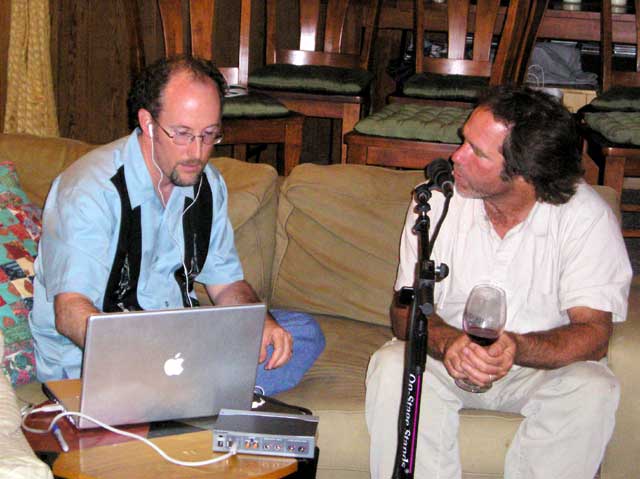
Podcasting allows students to use their technology-based
entertainment systems (iPods, MP3 players) for educational
experiences. Because students are already familiar with the
underlying technology, podcasting broadens educational
options in a nonthreatening and easily accessible manner. For
example, podcasting allows lectures or other course content
to be made available to students if they miss class. Beyond
missed lectures, podcasting can provide access to experts
through interviews. Podcasting is not limited to content deliv-
ered to the student, however; students can create their own
podcasts—as a record of activities, a way to collect notes, or a
reflection on what they have learned.
from www.educause.edu/eli/
iPod Killers For the Holidays

MP3 Newswire has an excellent rundown of 29 new digital portables for the upcoming season. From the article: 'We have run the iPod Killers for Christmas/Summer series since 2004. In that time we [have] reported on 149 portable players and NOT one iPod killer from the bunch. That said, [this time] we may actually have a couple of genuine challengers to Apple. This holiday season will see Microsoft pump tens-of-millions of dollars to hawk their new Zune portable, and SanDisk's 8GB e280 flash unit is compelling high-end users. Both can realistically grab double-digit market share from the iPod... Whether they do or not waits to be seen.' The article also makes a good case as to why the Sony PSP should be included in market figures for digital media portables.
http://hardware.slashdot.org
Subscribe to:
Posts (Atom)